


Up: CCWWF 2001 home page
Introduction
- gap winds are a low level flow of dense air constrained
vertically by an inversion, and horizontally by channel walls,
forced by synoptic- to meso- scale pressure gradients.
- can potentially occur wherever deep topographic valleys
exist
- events along the B.C. coast occur mainly during the winter when
cold arctic air moves into southern B.C. from Alaska.
- the Coast Mountains can block the cold air from reaching the
coast, except through ``gaps'' cutting through the mountains
- results in strong pressure gradients across the Coast Mountains
- air is strongly forced to flow down the pressure gradient
through the gaps / fjords to the coast
- position and internal structure are determined by topography of
gap and hydraulic effects (short temporal and spatial scales).
- resemble flow of water in an open channel (hydraulic flow)
BC Location map.
Howe Sound Location map.
Schematic visualization of gap flow in Howe Sound.
Wind roses at stations in Howe Sound.
Typical Synoptic Conditions
[OH: synoptic evol]
Synoptic conditions during a Gap wind episode.
- synoptic conditions determine the large-scale pressure gradients
which force the flow
- if the air is stratified (as is the case with cold arctic air),
then variations in the boundary-layer depth will also result in
pressure gradients which are superimposed upon the synoptic
gradients
- the wind responds to the total pressure gradient which is a
combination of large-scale (synoptic) and small-scale (due to
variations in boundary-layer depth).
Simple models of gap winds
- shallow, strongly stratified flow forced through a channel by a
PGF oriented along the channel, after a long time in a long channel
will undergo geostrophic adjustment:
- the flow will be forced up the right side of the channel due
to Coriolis turning
- the BL depth will increase on the right side so that the
along-channel PGF is changed into a cross-channel PGF and the down
channel wind is in geostrophic balance with the cross-channel PGF
- the time-scale for geostrophic adjustment is


 3 hours
- in a 100 km straight channel with winds less than 30 kmh,
adjustment could occur
- for stronger gap wind cases, the flow will not become
geostrophic
``Bernoulli'' and ``Friction'' winds
- Wind in channels has long been modelled using simple
relationships with along-channel pressure gradients.
- This seems a reasonable thing to do, based upon observations
from a number of places:[OH: Eisacktal]
Example of relationship between

P and wind.
- The equation of motion is:
where:
 is the vector wind, t is time,
  is density,
P is pressure, f is the Coriolis parameter,
is density,
P is pressure, f is the Coriolis parameter,  is a unit
vector directed upwards, and
is a unit
vector directed upwards, and  is the eddy stress. In this
equation: term 1 is the Lagrangian acceleration (ie. the acceleration
following the flow); term 2 is the pressure gradient force, term 3 is
the Coriolis force, and term 4 is friction.
is the eddy stress. In this
equation: term 1 is the Lagrangian acceleration (ie. the acceleration
following the flow); term 2 is the pressure gradient force, term 3 is
the Coriolis force, and term 4 is friction.
- assume that:
- the channel is straight along x
- the flow is in approximate steady-state so that term 1, the
Lagrangian time derivative, can be approximated by the advection
of velocity down the channel
- the effects of rotation in the channel are negligible so that
term 3 can be ignored
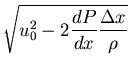
- the friction term (4) can be parameterized as

- Therefore equation 1 can be simplified to:
- This balance between pressure gradient, acceleration, and
friction represents an antitriptic wind
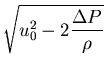
- If the friction term is neglected altogether, the result is a
form of the Bernoulli equation, which can be integrated to give:
where u0 is the an upstream speed,  P is the pressure
difference between the end point and the initial point, and u is the
Lagrangian velocity. For u0 = 0 this then reduces to:
P is the pressure
difference between the end point and the initial point, and u is the
Lagrangian velocity. For u0 = 0 this then reduces to:
u = 
|
(5) |
- This result describes the flow neglecting rotation, friction and
changes in elevation and will be called the ``Bernoulli'' model.
- Incorporating friction, equation 2 can be
solved analytically:
u = 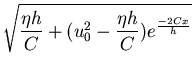
|
(6) |
where u0 is the upstream gap wind speed. This is called the
``Friction'' model. For u0 = 0 this simplifies to:
u =  
|
(7) |
as x approaches infinity, this reduces to:
u = 
|
(8) |
which represents the maximum steady-state speed. It can be shown that
the above solution reduces to the Bernoulli equation in the limit as
C  0.
0.
![\begin{figure}\includegraphics[bbllx=-50,bblly=150,bburx=520,bbury=620,height=5in,clip]{figs/analytic.eps}\end{figure}](Timg40.png)
Depiction of Friction model.
How well do they work?
Gap winds as hydraulic flows
- The Bernoulli and Friction models are appropriate for situations
where the pressure gradient is entirely determined by synoptic scale
processes
- for stratified flow situations, especially where a cold air
layer is surmounted by a much less dense air layer, it is possible
that pressure gradients within the flow resulting from variations in
BL depth are as important as synoptically imposed gradients
- in this situation, gap flow resembles the flow of water in a
channel, and thus a hydraulic analogy is appropriate.
- a hydraulic model is a superset of the Bernoulli /
Friction model which allows along-channel variations in the depth of
the cold lower layer and allows pressure gradients resulting from
sloped channels
Variable definitions.
Hydraulic theory
The simplified momentum equation is:
The equation of continuity in the gap wind is:
Q = uA = uh = uDbT = constant = uDbT = constant
|
(10) |
Define
SP = - (g' )-1dP/dx. Parameterize friction as:
The Energy Equation
Integrate the momentum equation (9) along x to find the Energy
Equation:
The Froude number,
F = u/(g'D)1/2 = ((Q2bT)/(g'A3))1/2, determines the flow regime:
- if the Froude number is less than 1, flow is subcritical
- if the Froude number is greater than 1, flow is supercritical
- and if it is equal to 1, flow is critical
The hydraulic jump
Energy equation breaks down in a turbulent hydraulic jump so can use
conservation of momentum to find the conditions on either side of the
jump:
( + A2(h2 - + A2(h2 -  )) - ( )) - ( + A1(h1 - + A1(h1 -  )) = 0 )) = 0
|
(13) |
Variable definitions at a hydraulic jump.
Hydraulic flow regimes.
Hydraulic model
Hydmod is subject to several assumptions:
- the flow must be steady in time, gradually varying in space,
1-dimensional, and on slopes which are not too steep;
- energy losses due to channel sinuosity are negligible;
- the gap wind should bear some resemblance to a dense fluid
flowing in a channel
- no entrainment of, or interactions with air above
Hydmod requires the following data as input:
- Q (the volume flow rate)
- cross sectional area, A, by height at locations along the channel
- e, the elevation of the channel floor along the channel
-
 ,
,
- dP/dx, the ``synoptic'' pressure gradient
- C, drag coefficient values
- hf, the height of gap wind at the end of
the channel
Hydraulic model.
Hydraulic model: subcritical flow becoming supercritical at a
contraction. (Flow is from right to left, there is a horizontal
contraction in the middle of the domain.)
Hydraulic model: supercritical flow becoming subcritical
upstream, and supercritical at a contraction. (Flow is from right to
left, there is a horizontal contraction in the middle of the
domain.)
Comparison of observations (triangle), RAMS mesoscale model
output (dashed), and two hydraulic model scenarios (heavy dashed),
for different scenarios.
Mesoscale models
- there has been success at simulating gap winds with mesoscale
models in research settings
- the horizontal resolution of ``operational'' mesoscale models,
until now, has been insufficient to adequately resolve the
topographic ``gaps''
- probably (?) the greatest limitation in accuracy for operational
mesoscale gap wind simulations, is accurate synoptic-scale
initialization
Conclusions
- simple gap wind models (ie Bernoulli or ``friction'') based upon
synoptic-scale pressure gradients have utility under some
circumstances [What circumstances?]
- under some circumstances, hydraulic models may give more
accurate results, but they have a disadvantage of requiring more
information
- mesoscale models will eventually be able to give good gap wind
forecasts, but more research and verification is required
References
There are have been several papers written on gap winds, such as:
- Overland and Walter, 1981. Mon. Wea. Rev., 2221-2233.
- Colman and Dierking, 1992. Wea. Forecasting, 49-64.
- Lackman and Overland, 1989. Mon. Wea. Rev., 1817-1833.
- Colle and Mass, 1998a,b. Mon. Wea. Rev., 28-52, 53-71.
- Jackson, 1996. Atmos. Ocean, 285-311.
- Jackson and Steyn, 1994a,b. Mon. Wea. Rev., 2645-2665,
2666-2676.
- Finnigan, Vine, Jackson, Allen, Lawrence and Steyn, 1994. Mon. Wea. Rev. 2677-2687.
Up: CCWWF 2001 home page
Copyright © 2001 by Peter L. Jackson
![\begin{figure}\includegraphics[bbllx=263,bblly=-63,bburx=635,bbury=483,height=7in,clip]{figs/g1mapbc.eps}\end{figure}](img1.png)
![\begin{figure}\includegraphics[bbllx=184,bblly=-50,bburx=571,bbury=604,height=7in,clip]{figs/g1locmaphs.eps}\end{figure}](img2.png)
![\begin{figure}\includegraphics[bbllx=38,bblly=208,bburx=558,bbury=624,width=7in,clip]{figs/3dmaphs_schem.eps}\end{figure}](img3.png)
![\begin{figure}\includegraphics[bbllx=61,bblly=157,bburx=515,bbury=742,height=7in,clip]{figs/hs_roses.ps}\end{figure}](img4.png)
![\begin{figure}\includegraphics[bbllx=-82,bblly=292,bburx=372,bbury=877,height=7in,clip]{figs/tt.eps}\end{figure}](img5.png)
![\begin{figure}\includegraphics[bbllx=20,bblly=175,bburx=573,bbury=586,width=7in,clip]{figs/dp1.eps}\end{figure}](img9.png)
![\begin{figure}\includegraphics[bbllx=-50,bblly=150,bburx=520,bbury=620,height=5in,clip]{figs/analytic.eps}\end{figure}](img40.png)
![\begin{figure}\includegraphics[bbllx=85,bblly=181,bburx=524,bbury=615,height=3in...
...85,bblly=181,bburx=524,bbury=615,height=3in,clip]{figs/mc_scat2.eps}\end{figure}](img41.png)
![\begin{figure}\includegraphics[bbllx=85,bblly=181,bburx=524,bbury=615,height=3in...
...85,bblly=181,bburx=524,bbury=615,height=3in,clip]{figs/mc_scat4.eps}\end{figure}](img42.png)
![\begin{figure}\includegraphics[bbllx=252,bblly=308,bburx=522,bbury=664,height=7in,clip]{figs/hyd_def.eps}\end{figure}](img43.png)
![\begin{figure}\includegraphics[bbllx=138,bblly=337,bburx=453,bbury=605,height=5in,clip]{figs/jump_def.ps}\end{figure}](img67.png)
![\begin{figure}\includegraphics[bbllx=70,bblly=215,bburx=520,bbury=748,height=7in,clip]{figs/composite.eps}\end{figure}](img68.png)
![\begin{figure}\includegraphics[bbllx=25,bblly=60,bburx=435,bbury=790,height=7in,clip]{figs/hydmod.eps}\end{figure}](img71.png)
![\begin{figure}\includegraphics[bbllx=36,bblly=196,bburx=557,bbury=609,height=3.5...
...36,bblly=196,bburx=557,bbury=609,height=3.5in,clip]{figs/rect-b.eps}\end{figure}](img72.png)
![\begin{figure}\includegraphics[bbllx=36,bblly=196,bburx=557,bbury=609,height=4in...
...6,bblly=196,bburx=557,bbury=609,height=4in,clip]{figs/rect-supb.eps}\end{figure}](img73.png)
![\begin{figure}\includegraphics[bbllx=18,bblly=414,bburx=576,bbury=622,height=2in...
...bblly=414,bburx=576,bbury=622,height=2in,clip]{figs/g2_comp0101.eps}\end{figure}](img74.png)
 =
=  -
-  +
+ 

 (
( ) =
) =  -
- 


 -
- 
 =
= 
 + g'
+ g' + g'
+ g' +
+ 
 -
- 
 = 0
= 0


 =
= 
 (
( + h + e) =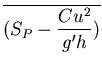
 x
x